scverse is an open source software platform for single-cell and spatial data analysis. I was invited to give a keynote at their third annual conference, held at DTU in Lyngby, Copenhagen, from October 12-14, 2026. Previous editions were held in Munich (2024) and Stanford (2025).
Choose your own keynote
Being invited for a keynote is both amazing and a little terrifying. You can talk about anything! You can talk about anything.
I decided that for this talk I mostly wanted to talk about use of AI agents in bioinformatics, and what the role of community projects like scverse and nf-core might be going forward. But I had a bunch of other ideas too.
My first idea was to do a “choose your own adventure book” kind of talk, where the audience could vote to go to different sections. But the voting seemed kind of difficult, and I figured that I’d need some kind of online / phone-based voting to make it work. Then I thought - if I’m doing that, then why don’t I go all in and drop the slides entirely?
So, there were no slides. Instead, the keynote was a pixel-art side-scrolling game: I walked a little pixel version of myself around a pixel version of the conference venue, and each room held a different topic. The audience scanned a QR code and ranked the rooms on their phones, with live bars beside the game showing where they wanted to go next.
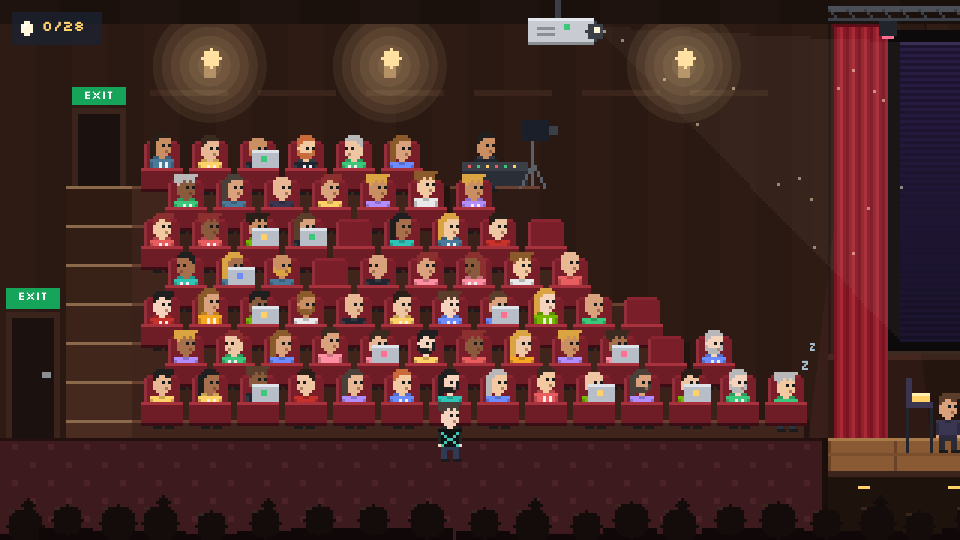
Lecture theatre
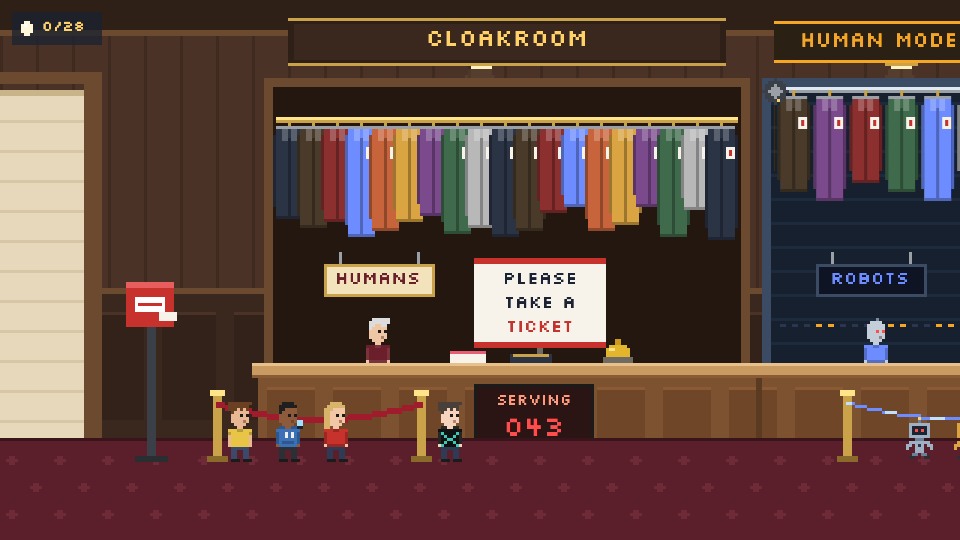
Cloakroom
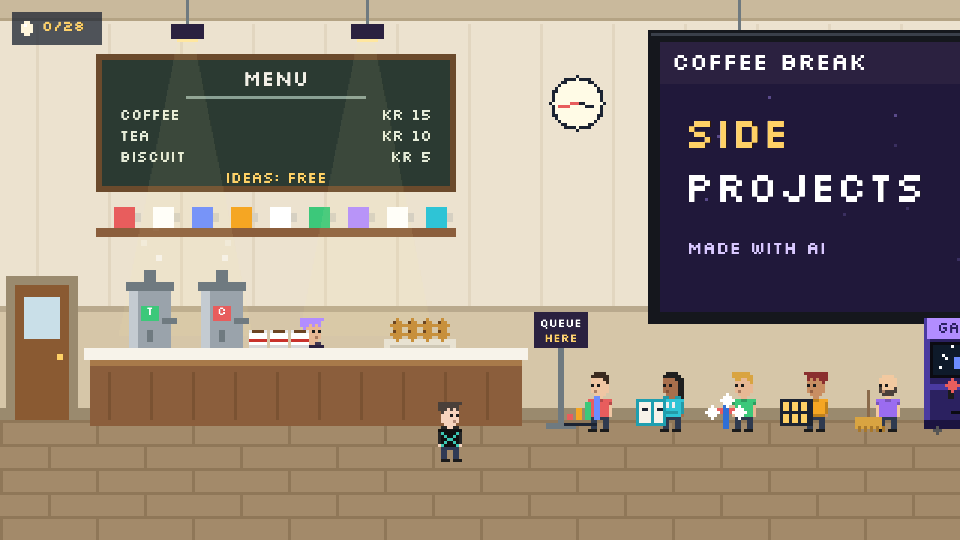
Coffee break
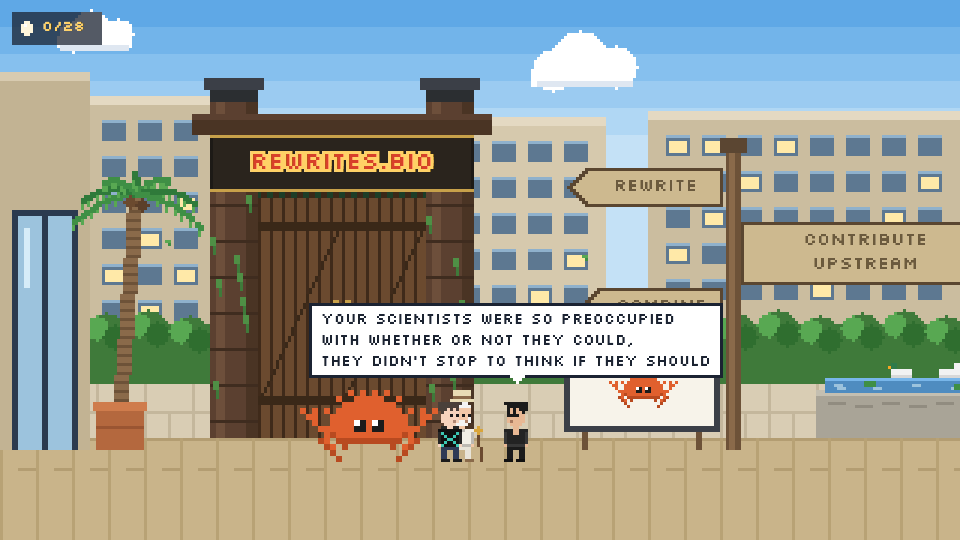
Courtyard
Questions came in from phones too. I could moderate them (on my phone) and put them up on screen, at which point one of the moderator’s NPC characters in the game walked up with a “?” and asked it in a speech bubble. People could send emoji reactions which floated up over the game, and when enough arrived at once the pixel crowd stood up.
You can play it below, or at https://ewels.github.io/scverse2026-keynote/ - click the game, then use the arrow keys to walk and space to take action:
The code is on GitHub at ewels/scverse2026-keynote. It is plain HTML, CSS and JavaScript with no build step, and all the art is drawn in code - there isn’t a single image file. For the talk I hosted it in CloudFlare in order to have the real-time interactivity. All of it was written by Claude, with a small Cloudflare Worker syncing votes and questions during the talk.
What I spoke about
The talk opened in the lecture theatre with Why bother writing software?: if an agent can write a tool in minutes, why build software carefully at all? I argued for deterministic building blocks, and for pooling AI effort into shared community tools rather than countless throwaway scripts.
From there, the audience sent me to:
- Building tools for agents (the cloakroom): your tools now have two audiences, people and AI agents.
I covered
llms.txt, agent environment variables,AGENTS.mdand why context is everything. - Side projects (the coffee break): AI means you can finally build the crazy ideas - contributor graphs, nf-docs, nf-metro, Stream Deck plugins and gfm-tidy.
- rewrites.bio (the courtyard): rewriting bioinformatics tools in Rust, when you should and when to contribute upstream instead, with RustQC, ruSTAR and FastQC-Rust as examples.
We ran out of time before reaching nf-core community building, MultiQC and documentation sites. They finished in that order in the final vote, separated by just a handful of points.
The audience
64 phones joined in, sending around 630 messages and 22 questions. The questions were brilliant, ranging from whether nf-core will suffer as LLMs default to Python, to scientific attribution for agent-written rewrites, to how hackathons change when projects are done in two hours and everyone eats cake for the next three days.
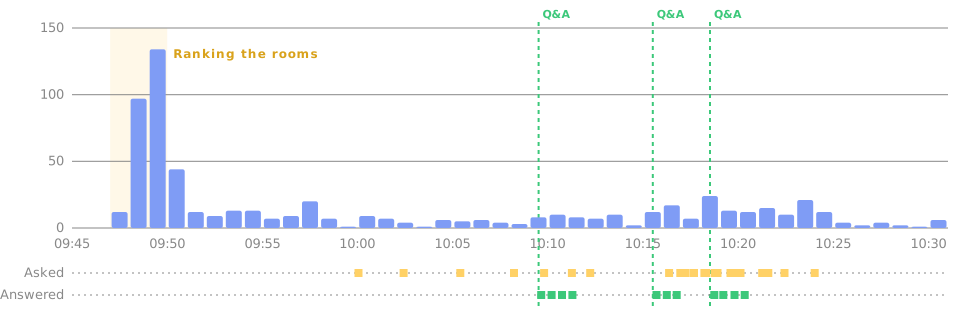
I got through 11 on stage - the rest, along with the route and minute-by-minute activity, are in the post-talk audience report.
Easter eggs
It wouldn’t be a proper game without secrets. The venue is packed with easter eggs - drink a little too much coffee, keep throwing bread in the pond until the seagulls take notice, or take out your frustrations on the foyer plants. Those are just a few; the rest are for you to find.